Hurricane Lowell Swerves Toward Hawaii as Islands Brace for Impact
Hurricane Lowell has made a dramatic turn toward Hawaii’s western islands, triggering a state of emergency, military deployment, and coastal warnings.
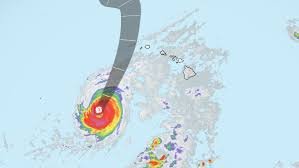
HONOLULU — A powerful Category 3 hurricane is spinning toward Hawaii’s western edges, forcing emergency declarations, military deployments, and stripping grocery shelves bare.
The storm took its time. Then, it turned.
Hurricane Lowell, packed with sustained winds of 120 mph, spent days locked on a safe westward path south of the islands. That protective barrier broke down over the weekend, setting off a scramble from Honolulu to Hanalei.
The Atmospheric Escape Hatch
For nearly a week, Lowell was trapped. A weak upper-level ridge of high pressure hung over the region like an invisible atmospheric wall, shielding the Hawaiian chain and pushing the storm safely out to sea.
But weather patterns are fickle. Over the weekend, a deep trough of cold air swept down from the north Pacific, colliding with a nearby low-pressure system.
The high-pressure shield crumbled. Freed from its track, Lowell executed a sharp right-hand turn, swinging north-northeast at 9 mph directly toward the state’s westernmost islands.
It is the third storm in just over three weeks to threaten the archipelago. Forecasters point to a supercharged Pacific hurricane season, heavily fueled by El Niño’s unusually warm ocean waters.
Searing Memories of Iniki
For longtime residents of Kauai, the storm’s sudden northerly trajectory brings back dark memories.
In September 1992, Hurricane Iniki took a similar path, roaring ashore on Kauai as a catastrophic Category 4 storm. It remains the most destructive hurricane in Hawaii’s recorded history, leaving a trail of shattered homes and decades of economic scars.
Lowell is not expected to repeat that direct hit. Current projections from the National Hurricane Center show the storm’s core passing roughly 100 miles west of Niihau and 150 miles west of Kauai between late Monday night and Tuesday morning.
Even if the eye stays offshore, Lowell’s massive wind field and heavy rain bands will still lash the islands. The storm is forecast to weaken slightly, approaching the islands as a strong Category 2 system.
Emergency Mobilization on Kauai
State officials are taking no chances. Hawaii Governor Josh Green signed a statewide disaster declaration on Sunday, a move that immediately frees up state funding and activates the Hawaii National Guard.
Specialized military assets are already moving. Six high-water vehicles have been deployed to Kauai to assist with potential water rescues and logistics in flooded coastal zones.
Local leaders are moving quickly to clear vulnerable areas. Kauai County Mayor Derek S.K. Kawakami announced the complete closure of all county parks and campgrounds, while opening five emergency refuge centers across the island.
“Closing our parks and opening refuge areas is not a decision we make lightly,” Mayor Kawakami said in a public address. “But it is the right call with a storm of this strength still turning toward us.”
Local emergency officials are urging residents to finish their preparations immediately. The message is simple: stay off the roads, secure loose outdoor objects, charge all personal electronics, and store enough water for several days.
Panic Buying and Empty Shelves
In Lihue, Kauai’s primary commercial hub of 8,000 residents, the atmosphere turned tense over the weekend.
Lines snaked out of local supermarkets. Shelves normally stocked with bottled water, canned goods, and batteries were wiped clean within hours.
Local real estate agent Lori Benkert described the mood as residents prepared for the inevitable disruptions.
“We’ll lose some power, probably have some trees, a bunch of tree limbs coming down,” Benkert said. “Everybody is probably going just to hunker down.”
The threat of power grid failures is high. High winds are expected to trigger widespread outages as falling trees take down utility lines across Kauai’s rugged, heavily forested interior.
Dangerous Surf and Coastal Flooding
While the strongest winds will likely miss the most populated islands, the ocean is already responding to Lowell’s energy.
Massive swells are radiating from the storm’s center, bringing historic surf to south-facing shorelines. The National Weather Service in Honolulu issued a high surf warning through Tuesday morning for south shores across Oahu, Maui County, and the Big Island.
Waves are expected to build rapidly. Breakers could reach 12 to 20 feet on Oahu, and up to 16 feet along the coasts of Maui and the Big Island.
Local meteorologists warn that these waves will likely wash over low-lying coastal highways, eroding beaches and threatening coastal properties. Runoff from heavy rainfall could also trigger mudslides on Kauai’s steep mountain slopes, cutting off remote communities.
The storm’s localized wind impacts will also be amplified by the islands’ dramatic topography. As Lowell’s outer wind bands hit Kauai’s steep peaks, the terrain will compress and accelerate the air, creating localized, hurricane-force gusts far stronger than the storm’s average sustained winds.
For now, the islands wait, watching the western horizon as the outer bands of Lowell begin to grey the Pacific sky.